Poster sizes explained: every standard size, and which one your wall wants
There are about a dozen poster sizes that matter, two or three that most people actually buy, and one simple rule for choosing between them. Here is the whole picture, drawn to scale.

Poster sizes look chaotic until you notice that nearly all of them belong to one of three proportions. Once you can see the proportion, you can see which frames fit, which sizes scale up and down cleanly, and why 24×36 became the default. This guide covers the standard US sizes, the European and A-series sizes you will meet online, and how to pick a size for a specific wall.
The standard poster sizes
These are the sizes you can walk into a store and buy a frame for. Everything is width by height in inches, portrait orientation; turn the numbers round for landscape.
| Size (in) | Size (cm) | Proportion | Where you see it |
|---|---|---|---|
| 8×10 | 20×25 | 4:5 | Photo prints, small frames, shelves |
| 8×12 | 20×30 | 2:3 | Small art prints, gallery walls |
| 11×14 | 28×36 | 11:14 | Photo frames, mats for 8×10 |
| 11×17 | 28×43 | 11:17 | Tabloid paper, flyers, small posters |
| 12×18 | 30×45 | 2:3 | Art prints, pairs and trios |
| 16×20 | 41×51 | 4:5 | Photo enlargements, mid-size frames |
| 16×24 | 41×61 | 2:3 | Art prints above a desk or dresser |
| 18×24 | 46×61 | 3:4 | Second most common poster size |
| 24×36 | 61×91 | 2:3 | The standard poster. Above a sofa or bed |
| 27×40 | 69×102 | 27:40 | Movie one-sheets |
| 30×45 | 76×114 | 2:3 | Statement size for big walls |
| 36×48 | 91×122 | 3:4 | Oversized, usually canvas |
Two European sizes turn up constantly on Scandinavian poster sites: 50×70 cm (about 19.7×27.6 in) and 70×100 cm (27.6×39.4 in). They are a 5:7 proportion and need their own frames. The A-series (A4 8.3×11.7 in, A3 11.7×16.5, A2 16.5×23.4, A1 23.4×33.1) is a 1:1.41 proportion and does not fit standard American frames at all without a mat.
Why proportion matters more than size
A proportion is the relationship between width and height. The same image can be printed at 8×12, 16×24 or 24×36 without cropping, because those three sizes are all 2:3. Print it at 16×20 (4:5) and something has to be cut off the top and bottom. This is why a good print shop offers one proportion in several sizes rather than every size under the sun.
The three proportions that cover almost every poster:
- 2:3 is the classic art print and poster proportion: 8×12, 12×18, 16×24, 24×36, 30×45. It is a touch taller than 4:5 and reads as a poster rather than a photograph.
- 4:5 is the photo proportion: 8×10, 16×20. Slightly stockier, very common in photo frames.
- 3:4 sits between them: 18×24, 36×48. Common for large posters and canvases.
Every piece at Hangkind is composed at 2:3 and printed in five sizes of that proportion, so the picture you see at 8×12 is exactly the picture you get at 30×45.
Which frames fit which sizes
Frames are sold by the size of the print they hold, so a 24×36 frame holds a 24×36 print with no mat. The traps:
- A movie poster (27×40) does not fit a 24×36 frame. Buy a 27×40 frame; they are common.
- An A-size print needs an A-size frame or a custom mat. Most US big-box frames will leave a gap.
- A 50×70 cm print is close to, but not the same as, 20×28 in. Buy the metric frame.
- If you want a mat, buy the frame one size up and have the mat cut to your print: a 16×24 print in a 24×36 frame with a wide mat looks like a gallery piece.
When you order a framed print from us, none of this applies: the frame is built to the print, the lip overlaps the edge by a quarter inch the way a professional framer does it, and it arrives ready to hang.
How to choose a size for a wall
One rule does most of the work: art should be about two thirds the width of the furniture beneath it. Measure the sofa, bed, console or desk, multiply by 0.66, and pick the size whose width lands closest. If nothing is under the wall, use two thirds of the wall section itself, and aim for the centre of the piece to sit about 57 to 60 inches from the floor, which is where a standing person's eye lands.
| Wall | Typical width | Size that works |
|---|---|---|
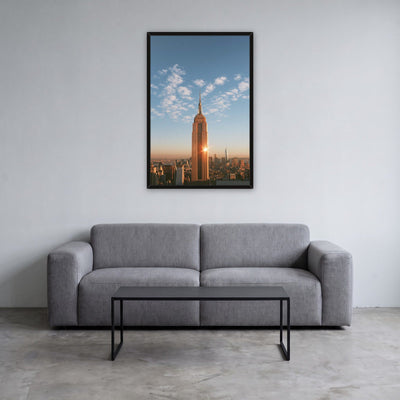
| Above a three-seat sofa | 84 in | 30×45, or two 24×36 side by side |
| Above a loveseat | 60 in | 24×36 |
| Above a queen bed | 60 in | 24×36, or a pair of 16×24 |
| Above a king bed | 76 in | 30×45, or two 24×36 |
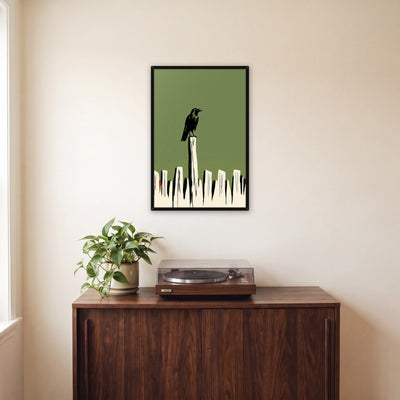
| Above a console or dresser | 48 in | 24×36 or 16×24 |
| Above a desk | 48 in | 16×24, or two 12×18 |
| Hallway, between doors | 30 in | 12×18 or 16×24 |
| Bathroom, above the toilet | 24 in | 12×18 or 16×24 |
| Shelf, leaning | any | 8×12 or 12×18 |
When in doubt, go one size up. The most common regret with wall art is buying small. A 24×36 looks enormous in the box and perfectly normal on a wall. If you are choosing between two sizes for a main wall, the larger one is nearly always right.
Small sizes and gallery walls
Small sizes have their own logic. An 8×12 or 12×18 is not a smaller version of a statement piece; it is for places a big piece cannot go, and for groups. Three 12×18 prints in matching frames, two inches apart, read as one object about 40 inches wide, which is a sofa-sized piece built from small parts. Mixed-size gallery walls work the same way: plan the outer shape first, usually a rectangle about two thirds the width of the furniture, then fill it with 8×12s, 12×18s and one or two 16×24s. The small wall art collection gathers the pieces that read well at these sizes.
Paper, canvas and the size question
Size changes which surface makes sense. Up to 24×36, a framed paper print behind acrylic is the classic choice and the easiest to live with. At 30×45 and above, canvas wins: it is lighter, it needs no glazing, and a big framed piece of paper is awkward to ship and hang. That is why our 24×36 posters come framed in wood while the 30×45 size ships as a framed canvas or an unframed print for you to frame locally.
A quick checklist
- Measure the furniture or wall section. Multiply by 0.66.
- Pick the size whose width is closest, rounding up.
- Check the proportion matches your frame if you are framing it yourself; 2:3 for our prints.
- Hang it with the centre at 57 to 60 inches, or the bottom edge 8 to 10 inches above the furniture.
- Step back to the doorway. If it looks small from there, it is small.
Shop the guide
The collections this guide points to.